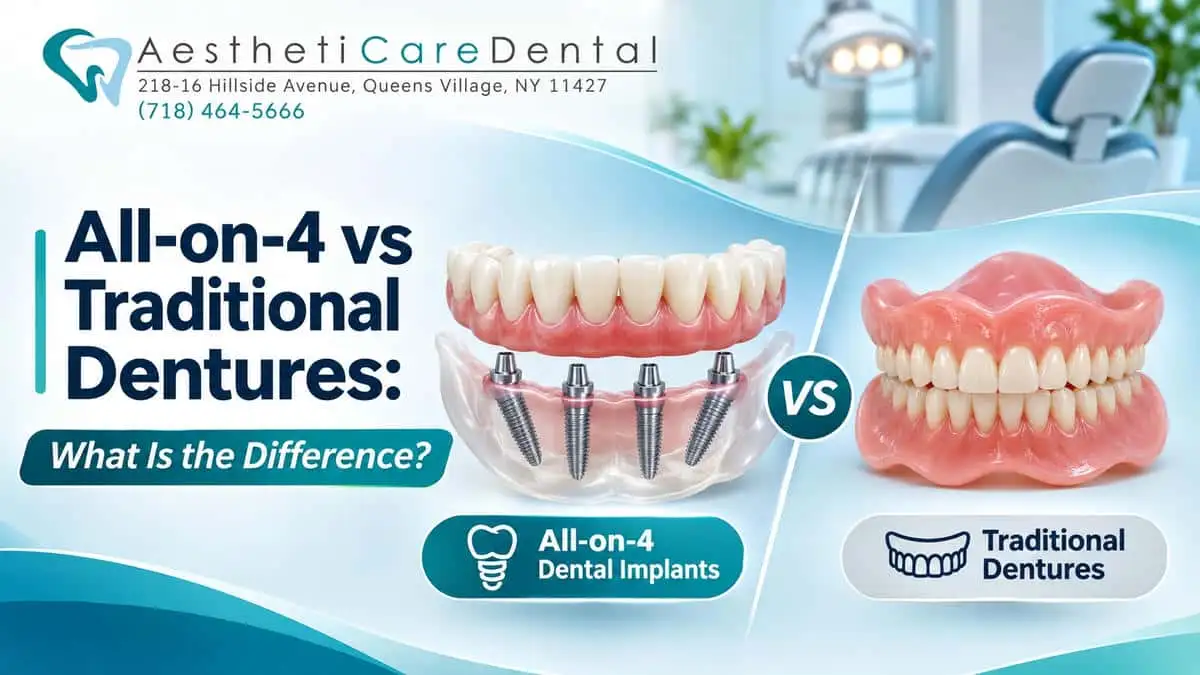
The gist: The All-on-4 dental implants concept replaces an entire arch of teeth in a different manner than traditional dentures. All-on-4 is based on four dental implants used as a support for a permanent structure beneficial to the bone, while traditional dentures only sit on gums.
Usually, people who are in search of the solution that would provide them with permanent full mouth teeth in Queens opt for All-on-4 rather than dentures because of its advantages in terms of bone health preservation and stability. The specialists of AesthetiCare Dental help people learn more about these two options based on their bone health and budget.
In case you are missing teeth in an entire arch, it is very important to understand the difference in how these two solutions are used every day rather than just to see their appearance.
All-on-4 Success Depends on Patient Selection and Risk Assessment
Researchers: David Soto-Peñaloza, collaborating lecturer in oral surgery and implant dentistry at the University of Valencia, and colleagues.
Key Finding: Understanding the Benefits and Limitations of All-on-4
David Soto-Peñaloza and his colleagues reviewed clinical research on the All-on-4 treatment concept, including its indications, treatment protocols, and potential complications. Although the review reported promising outcomes, it also highlighted limitations in the quality and follow-up of the available evidence.
For patients considering All-on-4, these findings highlight the importance of evaluating jawbone condition and overall oral health before treatment. Understanding potential biological and mechanical complications is also essential. Fixed full-arch restoration can be a favorable option for appropriately selected patients, but individual suitability and potential risks must be carefully assessed.
Soto-Peñaloza D, et al. The All-on-four treatment concept: Systematic review. Journal of Clinical and Experimental Dentistry, 2017.
Read the Original Open-Access Study →
🦷 What Is All-on-4?
Whenever we talk about an all-on-4, it refers to a method of replacement of an entire arch of teeth with the help of four dental implants, out of which two are placed vertically and two facing towards the back of the mouth. The top features of such a method are given below:
- ✓ Permanent solution: no need of removal for cleaning;
- ✓ Fixed directly into the jawbone during the process;
- ✓ The procedure helps preserve the jawbone;
- ✓ A temporary restoration can be placed on the same day as the operation;
- ✓ Several months are necessary in order to allow the jaw to heal before the final restoration is put in place.
🦷 What Are Traditional Dentures?
Conventional dentures are artificial teeth that can be removed and placed directly on the gums. They do not require the same kind of surgical process as dental implants and are typically kept in position due to suction. Notable features of traditional dentures include:
- ✓ Can be taken out of the mouth at the end of the day for cleaning purposes;
- ✓ No need for surgery;
- ✓ Do not help retain jaw bone therefore, loss of bone happens with time;
- ✓ May shift or feel unstable while talking or chewing;
- ✓ Usually needs either relining or replacement within 5-10 years.
🧾 All-on-4 vs. Traditional Dentures: Side-by-Side Comparison
| Feature | All-on-4 | Traditional Dentures |
| Stability | Fixed, permanent | Removable, can shift |
| Bone Preservation | Yes – stimulates jawbone | No – bone loss continues |
| Daily Care | Brush like natural teeth | Remove and soak/clean daily |
| Average Lifespan | 20+ years (implant posts) | 5–10 years before replacement/reline |
| Surgery Required | Yes | No |
| Speaking & Eating Comfort | Natural, no slipping | Can affect speech and limit certain foods |
🤔 What Are the Pros and Cons of Each Option?
All-on-4 Implants:
- ✓ It is an effective long-term method of treatment that works like real teeth;
- ✓ The bone structure of the jaw remains preserved;
- ✓ There are no problems with slipping, clicking, or using adhesives;
- ✓ It has a high initial cost since it is performed surgically;
- ✓ It requires time for healing before the final prosthetic.
Traditional Dentures:
- ✓ It does not require surgery to be fitted;
- ✓ It is less expensive than other techniques;
- ✓ It is possible for traditional dentures to slip or feel loose, as the shape of the bone may change over time;
- ✓ It does not stop the process of resorption of the bone;
- ✓ It requires removal for cleaning.
💰 How Do Costs Compare?
| Treatment | Average Cost Range | What’s Included |
| All-on-4 (per arch) | $18,000 – $30,000 | 4 implants + fixed prosthetic arch |
| Traditional Dentures (per arch) | $1,500 – $5,000 | Removable prosthetic, custom-fitted |
| Denture Relines/Replacements | $300 – $1,500 (every 5-10 years) | Adjustments as gums and bone change |
Pro Tip: Even though conventional dentures require lower initial costs, future spending for necessary relines and complete replacements make them generally more costly than All-on-4 once healing is complete.
Explore Your Tooth Replacement Options
Wondering whether All-on-4 dental implants or traditional dentures are right for you? AesthetiCare Dental can help you understand your options and explore a treatment plan based on your needs.
📍 218-16 Hillside Avenue, Queens Village, NY 11427
Explore All-on-4 Dental Implants🌿Whom Should Each Option Be Recommended To?
When to Choose All-on-4
You may be recommended to consider All-on-4 in case you prefer an unmovable and non-removable prosthesis, have sufficient bone density or are willing to have minimal grafting, and meet general health requirements for the surgery.
When to Choose Traditional Dentures
You may be recommended to consider dentures in case you want to avoid surgery and prefer the faster and cheaper option and have health restrictions preventing implant placement.
Bone Structure and Bone Loss
Bone structure: the considerable degree of bone loss may be treated with All-on-4 solution since it allows achieving reliable results with its type of angled implants.
How Habits and Lifestyle Affect Your Choice
Habits and lifestyle matter: patients preferring stable food consumption and speaking may favor All-on-4.
Note: A consultation with imaging is the most reliable way to determine which option fits your jaw structure, health, and goals.
Read also: What Is a Smile Makeover and What Treatments Can It Include?
🦷 What Does Treatment Look Like for Each Option?
All-on-4 Process:
- Consultation & 3D Imaging – Bone density and jaw structure are evaluated to plan implant placement.
- Implant Surgery – Four implants are placed in a single appointment, often with a temporary prosthetic attached the same day.
- Healing & Final Prosthetic – After 3-6 months of osseointegration, the permanent fixed arch is placed.
Traditional Denture Process:
- Impressions & Measurements – Molds of the gums and jaw are taken to design a custom-fitted prosthetic.
- Fitting & Adjustments – The denture is fitted and adjusted for comfort and bite alignment.
- Ongoing Maintenance – Periodic relines are needed as the jawbone and gums change shape over time.
A Fixed Implant Solution Is Not Automatically Best for Everyone
Researchers: Pierre-Luc Michaud, Professor and Head of the Division of Prosthodontics at Dalhousie University’s Faculty of Dentistry; Georgi Talmazov; and Hillary Dort, co-authors of a systematic review published in the Journal of Dentistry in January 2025.
Key Finding: Comparing Comfort and Quality of Life
Pierre-Luc Michaud and his colleagues evaluated studies comparing conventional upper dentures with implant-assisted prostheses for the upper jaw. Their systematic review found no clear evidence that either approach was superior in terms of patient satisfaction and quality of life. The researchers also highlighted limitations in the available studies.
For individuals comparing All-on-4 with traditional dentures, these findings highlight the importance of looking beyond whether a restoration is removable or fixed. Factors such as oral health, bone condition, treatment expectations, maintenance requirements, and individual circumstances should also be considered when discussing suitable tooth replacement options with a dental professional.
Are Patient-Reported Outcomes Improved by Implant-Assisted Maxillary Prostheses Compared to Conventional Maxillary Dentures? A Systematic Review.
Read the Original Research →
📍 Considering Permanent Full-Mouth Teeth in Queens?
Patients throughout Queens Village, Bellerose, Floral Park, and Hollis come to AesthetiCare Dental to weigh All-on-4 against traditional dentures for full-arch tooth replacement. Whether stability, cost, or timeline is your top priority, our team walks you through imaging and candidacy so you can choose the option that truly fits your life.
❓ Frequently Asked Questions
1. Which is more comfortable, All-on-4 or dentures?
All-on-4 is fixed in place and generally feels more stable and natural, since it doesn’t rely on suction or adhesive like traditional dentures.
2. Are traditional dentures cheaper than All-on-4?
Yes, upfront — though dentures require periodic relines and replacement, adding cost over the years that All-on-4 largely avoids.
3. Is it feasible for me to transition from a denture to All-on-4?
Most of the time yes, provided you have sufficient bone density or are a suitable candidate for grafting, as determined by your dentist.
4. Would I be able to feel All-on-4 implants like natural teeth?
Yes, because the implants are fixed and secured to the jaw bone, patients regard that these implants behave similarly to real teeth.
5. What is the time frame for All-on-4 treatment?
All-on-4 process typically involves 3-6 months of healing period before the final restoration, while traditional dentures can take only a few weeks.
6. Would my jaw bone shrink with these treatments?
Bone loss will continue in the case of conventional dentures, whereas All-on-4 saves the jaw bone density because the implants work directly on the bone.
📅 Schedule a Consultation to Compare Your Options
Not sure if All-on-4 or traditional dentures are the right fit for your smile? Let our team evaluate your bone health and walk you through both paths.
Medical Disclaimer: This blog is for informative uses only and in no case should be taken as a replacement for qualified medical advice, diagnosis, and treatment. A trained medical professional should be consulted. Any medical condition that warrants immediate medical attention should be taken seriously.