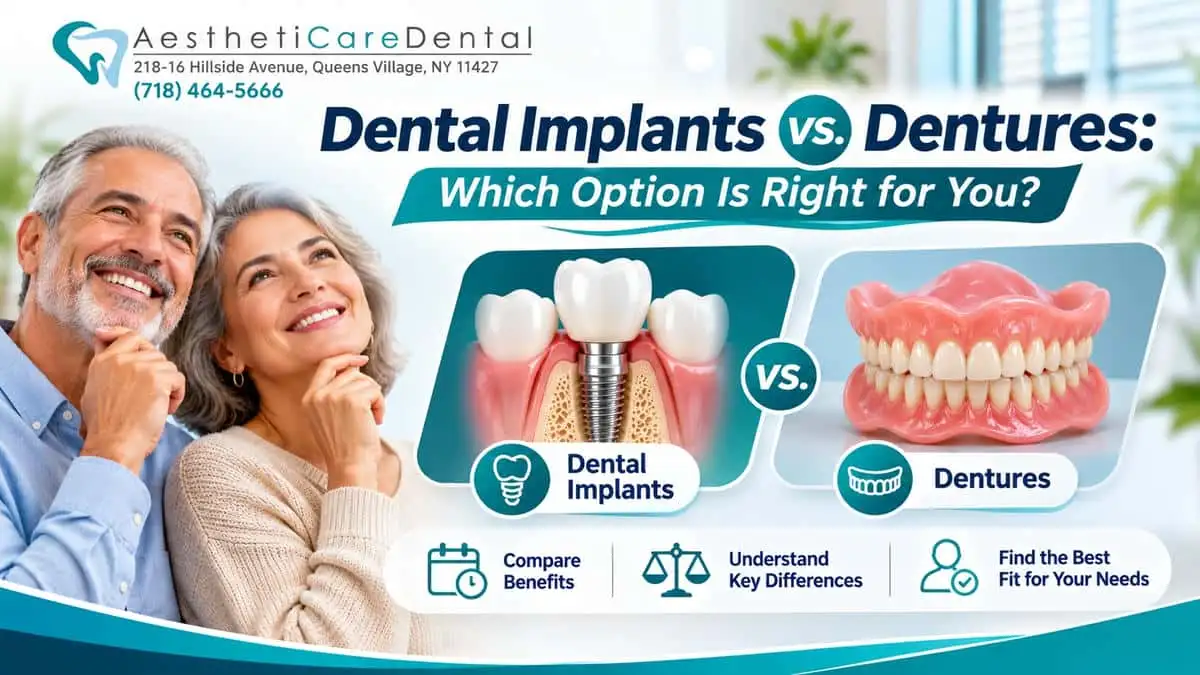
In this blog post, we will try to compare dental implants Queens Village patients trust with traditional dentures. See costs, comfort, lifespan, and who each option suits best.
🏁 Which Is Better: Dental Implants or Dentures?
If you want a long lasting alternative that feels natural and helps save your jawbone then dental implants are a good option for you, as long as you’re able to spend more money beforehand. Alternatively, if you are looking for something cheaper and quicker or if surgery is not what you’re interested in, then dentures would be the better option for you. Alternatively, many end up getting the middle option which is implant-supported dentures.
The examination performed will assist in determining which option is best for you. While there is no single solution relevant for everyone in the case of dental replacement, the better option will always depend on your needs and choice.
🧭 What’s the Real Difference Between Implants and Dentures?
It must be noted that dental implants integrate into the jawbone, while dentures exist solely above the gums. A dental implant generally consists of a small post made of titanium and functions like a tooth root. Unlike a dental implant, denture usually consists of a set of artificial teeth attached to a gum-colored base, resting on the gums and held in place by various means.
| Feature | Dental Implants | Traditional Dentures |
| How they stay in | Fused with the jawbone | Rest on gums (suction or adhesive) |
| Removable? | No, cared for like natural teeth | Yes, taken out daily |
| Jawbone support | Helps preserve bone | Doesn’t stimulate bone |
| Chewing feel | Very close to natural | Can feel less stable |
| Typical lifespan | Often decades with care | Often 5-10 years before relining or replacing |
| Upfront cost | Higher | Lower |
| Treatment time | Months | Often weeks |
| Surgery needed | Yes, minor oral surgery | Usually not |
Note: Lifespans are general estimates and vary by person.
👥 Which Type of Patient Are You?
While specs do contribute to the overall narrative of a patient’s situation, they are but one component to their entire story.
- The “Let me forget” patient: You are likely looking for a solution that does not involve any special effort or adhesive glues, that is, operations that provide you with the same function and feel as if you never were using artificial teeth in the first place, and one of the ways to achieve such results is through implants.
- The “Let’s fix this in no time” patient: Many may only need denture and thus save up on costs and time.
- The “I’m not sure I want to go through with it” patient: There are cases when doctors may decide that surgeries may not be an option due to health problems, use of certain medications, or low bone density. Dentures remain a reliable avenue to help solve these problems.
🥩 Can I Still Eat Steak, Apples, and Crunchy Foods?
This is the query we ask the most. Implants are anchored in the bone underneath. That is why patients find chewing to be much easier than they did previously with their dentures. Lower dentures may move in the mouth from time to time and some people tend to stay away from crunchy or chewy foods.
🗣️ Is My Speech Going to Change?
Adjusting to new dentures can take some time. Some patients may experience a slight lisp while learning how to speak normally. Unlike dentures, implants tend to be easier to speak with as they resemble your natural teeth and complete adjustment period lasts only for a little while.
🦴 What Happens to the Jaw Bone After the Teeth are Lost?
Whenever a tooth is lost, the underlying jaw bone will shrink gradually because it does not receive exposure to chewing forces anymore. Implants support jaw bone, which is not the case with dentures that become loose with time and will therefore, require relines or replacement.
🌟 Why Do So Many Patients Lean Toward Implants?
Individuals opting for implants report the following advantages:
- ✓ The implant provides a feeling of stability and security in eating and speaking;
- ✓ There is no need for mess-free adhesives or removal every night;
- ✓ It maintains jawbone structure and shape of face;
- ✓ Neighbouring teeth are preserved as they are not filed down;
- ✓ It is a very long-lasting solution if maintained well;
- ✓ Natural-looking finish.
However, certain downsides must be considered: high initial cost, longer wait for getting implants, and a condition of having sufficient amount of healthy bone and gums.
Explore Your Tooth Replacement Options
Not sure whether dental implants or dentures are right for you? Schedule a consultation with AesthetiCare Dental to discuss your oral health, preferences, and personalized treatment options.
📍 218-16 Hillside Avenue, Queens Village, NY 11427
🧮 How Much Do Implants and Dentures Cost?
A doctor can’t quote a fair price without seeing your mouth, but the way costs are built is easy to understand.
| Cost Question | Dental Implants | Dentures |
| Upfront investment | Higher | Lower |
| Extra procedures | Possible bone graft or extraction | Possible extraction |
| Maintenance over time | Regular checkups and cleanings | Relines, repairs, adhesives, replacements |
| Long-term picture | May cost less over many years for some patients | Lower entry cost, but ongoing upkeep |
Implant-Supported Dentures Still Require Ongoing Maintenance
Research by: André Assaf and colleagues, with institutional background including the Cedars Dental Center research team and the Faculty of Dentistry, Beirut Arab University .
A systematic review examined the prosthetic maintenance requirements of different mandibular implant-supported overdenture attachment systems. The research explored the types of maintenance complications that may arise after treatment.
Key findings: Implant-supported overdentures may require periodic adjustments, repairs, and maintenance. The review also indicated that no single attachment system can be considered universally superior to all others.
Although implant-supported overdentures generally provide greater stability than conventional removable dentures, they are not maintenance-free. Attachment components and prosthetic structures may require professional attention over time.
What this means for patients: Regular dental follow-up is essential even after receiving implant-supported dentures. Routine examinations allow your dentist to assess implant health, evaluate denture fit and function, and identify any components that may need adjustment or repair.
🛡️ Does Insurance Help?
It is dependent on the insurance plan you have. Various plans provide partial coverage for dentures. However, on the contrary, implant coverage ranges from full coverage to lacking coverage completely. We advise that you check with your plan regarding your benefits. Our staff will also assist you in understanding your coverage.
🛠️ What Does the Process Look Like for Each?
| Stage | Implants | Dentures |
| First visit | Exam, scans, planning | Exam, impressions, planning |
| Prep | Extractions or bone graft if needed | Extractions if needed |
| Main procedure | Implant placement | Denture fitting |
| Healing | Often 3-6 months | Gums settle over weeks |
| Final result | Custom crown, bridge, or denture attached | Final denture adjusted for fit |
Note: Timelines vary, so our dentist will map yours out.
A regular implant journey entails the following stages:
- ✓ Initial assessment, accompanied by 3D imaging of the condition of the bone, gums, and overall health as well;
- ✓ Implant procedure done under local anesthesia, that also offers sedation if necessary;
- ✓ Healing to allow the bone to grow around the base of the implant;
- ✓ Attaching the final restoration, which means attaching your special teeth.
🔀 Is There a Middle Ground?
Yes, and it’s popular. Implant-supported dentures use a few strategically placed implants to hold a denture firmly in place, so it doesn’t slide around.
| Option | How It Works | Best For |
| Traditional denture | Rests on gums | Budget-minded, non-surgical needs |
| Implant-retained denture | Snaps onto a few implants, removable | Better stability without a full set of implants |
| Fixed full-arch implants | Permanent teeth on implants | Maximum comfort and a natural feel |
How Implant-Supported Dentures May Improve Comfort and Satisfaction
Research by: Ahmad Kutkut , Professor of Prosthodontics, and colleagues at the University of Kentucky College of Dentistry .
A systematic review by Ahmad Kutkut and colleagues examined studies comparing conventional complete dentures with implant-retained overdentures. The researchers evaluated differences in chewing function, prosthesis stability, comfort, and patient satisfaction.
Key findings: The review found that mandibular overdentures retained by two dental implants generally provide better chewing function, improved stability, greater comfort, and higher patient satisfaction compared with conventional complete dentures.
These potential advantages make implant-supported overdentures an appealing option for patients who experience difficulties with the stability or functionality of traditional dentures. However, these findings do not mean implant treatment is necessarily the best choice for every patient.
What this means for patients: Choosing between conventional dentures and implant-supported overdentures requires an individual assessment. Factors such as oral health, general health, treatment costs, and personal preferences should all be considered. A dental professional can help determine which option is appropriate for your needs.
🧑⚕️ How Do I Actually Decide?
Here’s an easy way to define your ambitions:
- List your priorities: It is comfort, price, speed, or durability.
- Get a professional assessment: Your bone height, gums, and medical history play an important role in how realistic your plan is.
- Get a written proposal: You need to see everything clearly laid out before you make any decisions.
🗺️ Looking for Dental Implants in Queens Village?
When you are looking for dental implants, accessibility is very important. Repairs on implants as well as changes to dentures require return visits to the dentist, and being nearby makes it easier for the patient.
Read also: —-Am I a Good Candidate for Invisalign?
🙋 Frequently Asked Questions
Can I transition from dentures to implants afterwards?
Generally, yes. A scan will indicate if you have enough bone, and you can utilize a graft if you don’t.
Is the pain of implants greater than that of dentures?
Implants entail only mild surgery, rarely causing any serious problems. Dentures can be cumbersome, whereas using implants is easy.
Should I wear my denture when sleeping?
Dentists typically advise against it, suggesting they be taken out every night in order to allow your gums to rest. It is best to check with your dentist, though.
How long does it take to replace my teeth using implants?
It will depend on the healing process and whether you will require something to be done beforehand. Some patients may be given temporary teeth during the process.
Can I use different cleaning techniques for implants than for dentures?
Cleaning the implants involves brushing and flossing them like regular teeth, while dentures should be removed, brushed, and soaked on a daily basis.
🚪 Ready to Compare Your Options in Person?
Your dental health is personal and the treatment starts with understanding your situation. The team is here to help you analyze your options and reach an informed conclusion.
Reading may take you somewhere, but a real examination gets you real answers. You may come to AesthetiCare Dental for a consultation, ask any questions you wish and go home with a completed plan.
Medical Disclaimer: This blog is for informative uses only and in no case should be taken as a replacement for qualified medical advice, diagnosis, and treatment. A trained medical professional should be consulted. Any medical condition that warrants immediate medical attention should be taken seriously.